
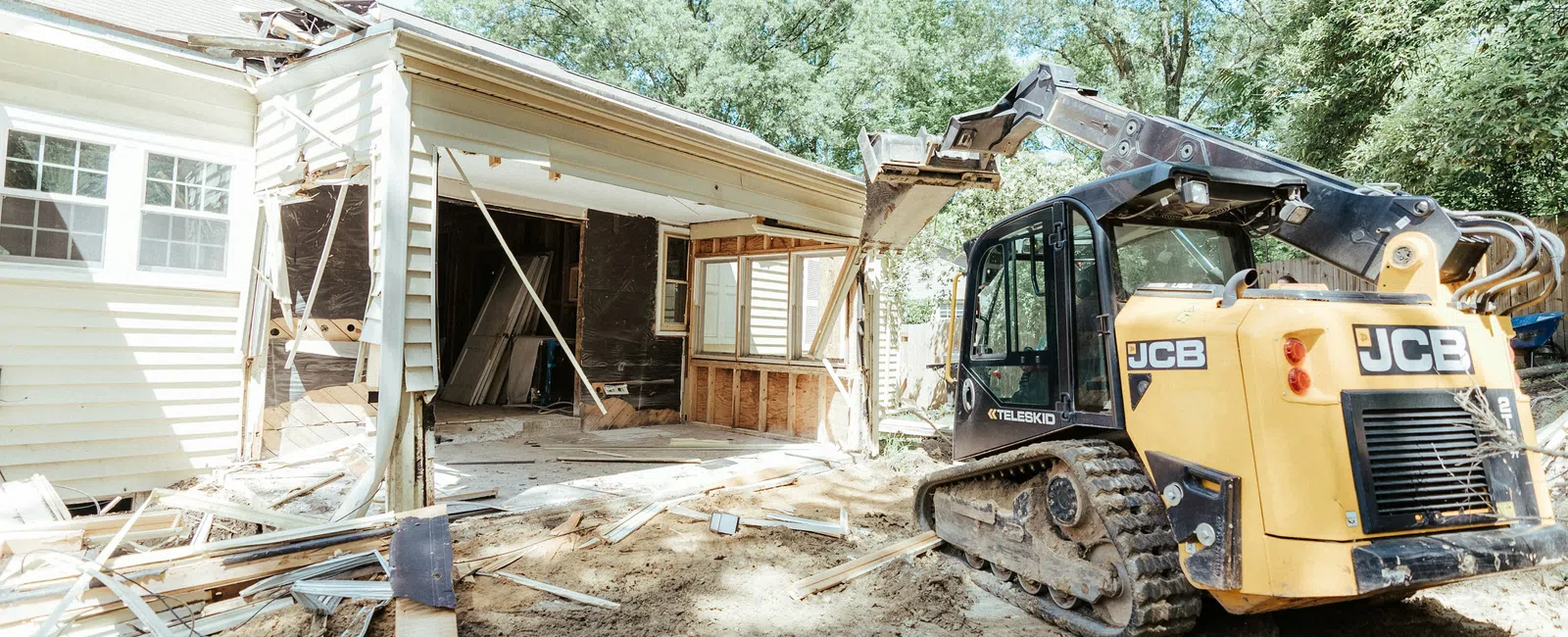
Most full house demolitions fall somewhere between $4,000 and $15,000, but that range is wide because no two houses sit the same way, are built the same way, or hide the same things behind their walls. Knowing what moves the number lets you plan a real budget instead of bracing for a surprise.
What Drives the Cost of Demolishing a House
Square footage sets the starting point, since a bigger house means more structure to take down and more material to haul. From there, a handful of factors decide where in the range you land.
Construction type matters as much as size. A wood-framed house comes down faster than one built with brick, block, or masonry, which take more time and heavier equipment to break and sort.
The foundation is often the hidden cost. A house on a slab is simpler than one over a basement or crawlspace, where the walls have to come out and the cavity has to be backfilled and compacted. Breaking and hauling that concrete foundation and slab is frequently a separate line on the estimate.
Access and lot conditions shape the method. A house on an open lot lets big equipment work fast. A tight infill lot with neighbors close on both sides, common across the Atlanta metro, calls for slower, more controlled work and protection for everything nearby, which adds labor.
Hazardous materials are the most common budget surprise. Homes built before the 1980s often contain asbestos or lead paint, and detecting and safely removing asbestos before demolition is a regulated, licensed step that has to finish before the teardown starts. Testing early keeps it a line item instead of a mid-project shock.
Debris and disposal carry real weight. A demolished house produces significant tonnage, and tipping fees scale with it. Recycling concrete, metal, and wood offsets part of that, and our debris removal and recycling team keeps as much as possible out of the landfill.
Permits and utility disconnects round out the scope. Every Georgia jurisdiction requires a demolition permit, and gas, water, electric, and sewer all have to be properly capped and documented before work begins.
Full Demolition vs Deconstruction
There is more than one way to take a house down, and the choice affects both cost and timeline. Standard mechanical demolition uses an excavator to bring the structure down quickly, then sorts and hauls the debris. Deconstruction takes the house apart by hand to salvage lumber, fixtures, and materials, which is slower and costs more up front but can recover value and may qualify for a tax deduction on donated materials. Most homeowners choose mechanical demolition for speed and price; the method that fits your project depends on your goals and the house itself.
Budgeting Beyond the Teardown
The teardown is only part of the project. A realistic budget also accounts for what comes before and after.
- A contingency for surprises. Older homes hide things behind walls and under floors. A cushion keeps a discovery from stalling the job.
- Site work after demolition. Grading, fill, compaction, and capping or relocating utilities to ready the lot for construction are their own scope, and folding them into the demolition contract usually beats hiring a separate crew.
- Permit and inspection fees, which vary by jurisdiction across Georgia and can affect your timeline as much as your budget.
- More than one written quote. An itemized estimate that breaks out abatement, hauling, and site work tells you far more than a single bottom-line number.
Why House Demolition Is Not a DIY Job
Whole-house demolition combines the hazards no homeowner should take on alone: load-bearing structure, live gas and electrical service, and asbestos or lead in older homes. A wall coming down wrong, an uncapped line, or disturbed asbestos turns a savings plan into an injury, a code violation, or an environmental cleanup. A professional residential demolition crew removes those risks: permits handled, utilities coordinated, hazardous materials abated, and the lot left graded and ready for what comes next.
Frequently Asked Questions
How is house demolition priced?
It starts with square footage and construction type, then layers in foundation type, access, hazardous material findings, and debris tonnage. Anything beyond the basic teardown, like basement removal or asbestos abatement, is itemized. If a quote is one flat number with no breakdown, ask for details.
Do I need a permit to demolish a house in Georgia?
Yes, in every jurisdiction we work in. A demolition permit is required, along with documented utility disconnects and, for older homes, asbestos clearance before the permit is issued. We handle the permitting as part of the project.
What happens to all the debris?
It is sorted and hauled, with concrete, metal, and wood recycled wherever possible to cut landfill tonnage. We include debris removal and recycling so you are handed back a clean, build-ready lot.
Get a Real Number for Your Teardown
A range gets you planning, but your house, your lot, and your goals set the real figure, and that takes a walkthrough. BHH Demolition is veteran-owned and operated, led by U.S. Army veteran Grady Brain, with more than 23 years of demolition experience, a safety record we stand behind, and recycling built into every job. We serve the Atlanta metro and communities across Georgia from our base in Oxford.
Call us or request your free on-site quote online, and we will turn that range into a firm number for your project.