
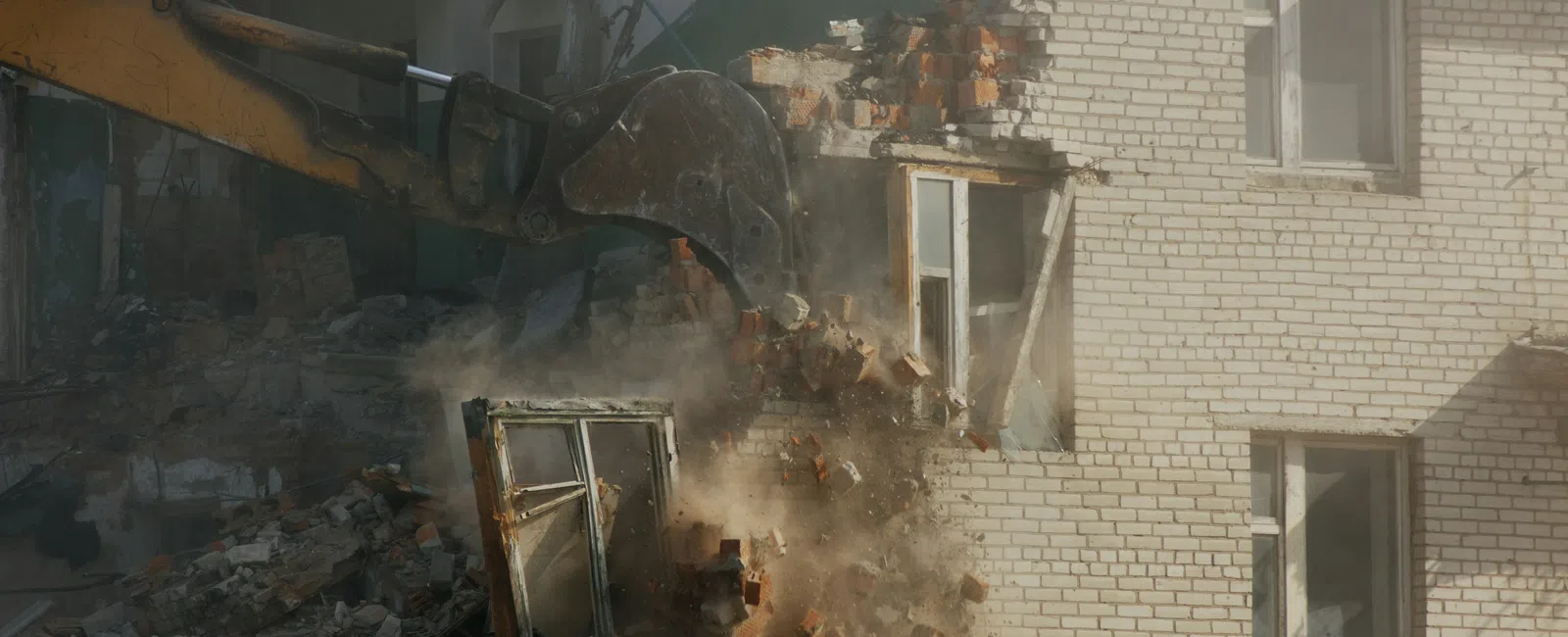
Demolition is not one job. The method that levels a warehouse in a day would be the wrong choice for stripping a tenant space inside an occupied building, and the technique that brings down a high-rise has no business in a residential backyard. The structure, the site, and what happens to the space next all decide the approach.
Explosive Demolition and Implosion
The version everyone has seen on the news: strategically placed charges drop a large structure into its own footprint in seconds. Implosion is reserved for very tall or massive structures where mechanical methods would take too long or put crews at height for too many days. It demands months of engineering, strict permitting, and large evacuation zones, which is why it represents a tiny fraction of real-world demolition. For nearly every commercial project in Georgia, there is a faster, safer, and far less disruptive answer.
Mechanical Demolition
This is the workhorse of the industry and what most projects actually use: excavators, skid steers, hydraulic breakers, and grapples taking a structure down piece by controlled piece. Mechanical demolition handles everything from a single-story retail shell to a multi-story office building, and it pairs naturally with on-site debris sorting so steel and concrete head to recycling instead of the landfill. It is the backbone of our commercial demolition work across the state.
Demolition by Hand
Sometimes the right tool is a crew, not a machine. Hand demolition is used where precision matters more than speed: tight urban sites where equipment cannot operate safely, structures that share walls with buildings staying in place, or removals around utilities that must stay live. It is slower and more labor-intensive, which is why it is usually combined with mechanical methods rather than used alone.
Selective and Interior Demolition
Selective demolition removes specific parts of a building while protecting everything else: a back wing comes off, the rest stays open for business. Its close cousin, commercial interior demolition, strips a space back to its shell for a renovation or tenant build-out, taking out partitions, ceilings, flooring, and fixtures without touching the structure. Both reward careful planning, because the value is in what does not get damaged. They are also where material recycling shines, since intact lumber, metal, and fixtures can be recovered rather than crushed.
Deconstruction
The slowest and greenest option: taking a building apart largely by hand specifically to salvage materials for reuse. Full deconstruction makes sense when a structure holds real material value, like old-growth framing lumber or architectural elements. More often, contractors blend it with other methods, deconstructing the valuable parts and demolishing the rest mechanically.
How a Contractor Chooses the Method
The decision starts with a site assessment: the structure's size, construction, and condition, what surrounds it, and what the cleared site needs to become. Hazardous materials shape the plan early, because asbestos has to be found and removed before demolition no matter which method follows. From there it comes down to access, timeline, disposal strategy, and budget.
Method also drives price, since equipment, labor intensity, and debris volume differ sharply between approaches. We break down what commercial demolition costs per square foot separately if you are budgeting a project.
Frequently Asked Questions
What are the three types of demolition?
The classic three-way split is explosive, mechanical, and manual (by hand). In practice the industry works with more distinctions, including selective demolition, interior demolition, and deconstruction, because modern projects rarely fit neatly into three boxes.
Which type of demolition does my project need?
It depends on the structure, the site, and your end goal, which is why the answer should come from a walkthrough rather than a guess. Most commercial and residential projects in Georgia land on mechanical, selective, or a combination. Our demolition services cover the full range, and the assessment that picks the method is part of every quote.
Is explosive demolition ever used for ordinary buildings?
Practically never. Implosion is engineering-heavy, permit-heavy, and disruptive, so it is reserved for structures too large to bring down any other way. An excavator handles the typical commercial building faster and with far less impact on the neighbors.
Not Sure Which Method Your Project Needs?
That is our job, not yours. BHH Demolition is veteran-owned and operated, led by U.S. Army veteran Grady Brain, with more than 23 years of matching the method to the building, an impeccable safety record, and debris recycling on every project. From our base in Oxford we serve the Atlanta metro and communities across Georgia.
Call us or tell us about your project online, and we will walk the site, pick the right approach, and put a free quote behind it.