
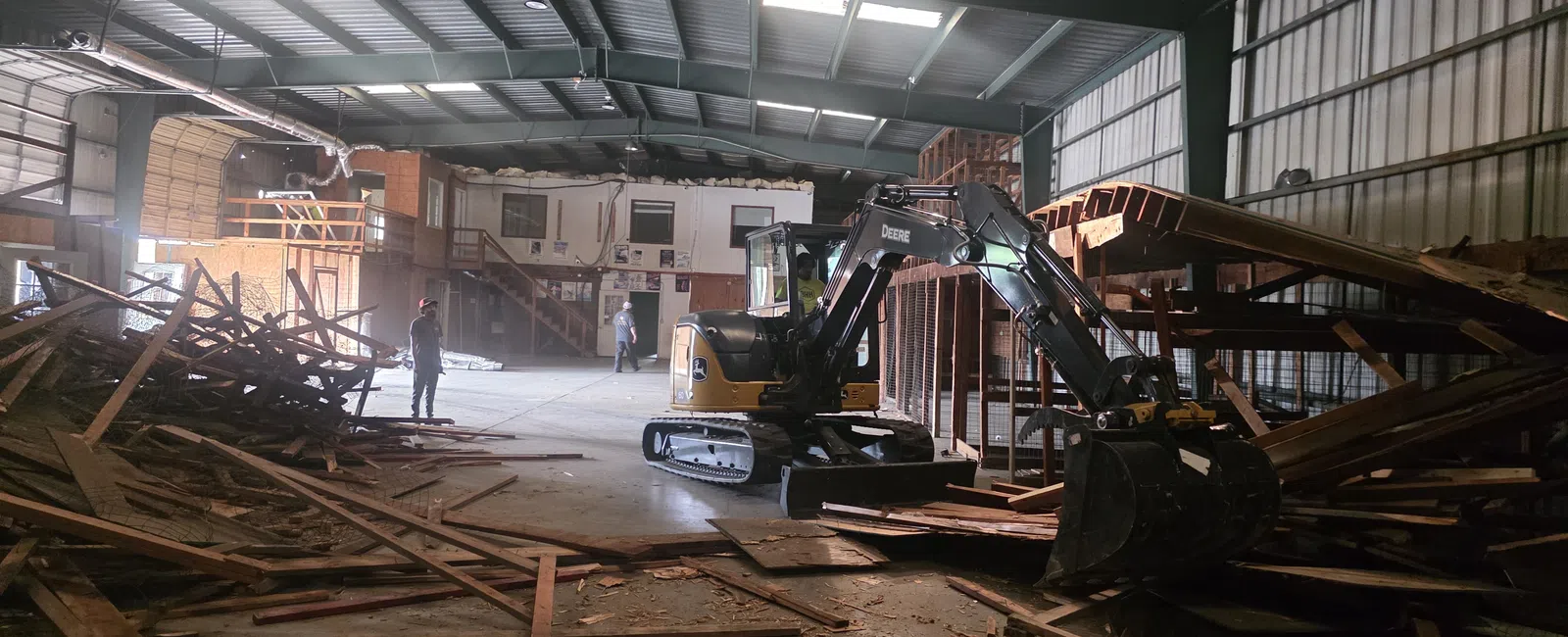
Industrial demolition is the takedown of factories, processing plants, warehouses, power facilities, and the heavy structures that run them. It looks like demolition writ large, but the differences are not just about size. Structural steel, embedded machinery, live process systems, and the contamination that can come with decades of operation all make industrial work its own discipline, with its own sequence and its own rules. Here is what the job actually involves and how it differs from a standard building teardown.
What Sets Industrial Demolition Apart
A commercial building is mostly an empty shell by the time demolition starts. An industrial facility rarely is. Several things make it a different animal.
The structures are heavier and more complex. Steel frames, reinforced concrete, tall stacks, silos, tank farms, and overhead cranes do not come down the way a retail box does. They demand engineering, sequencing, and equipment built for scale.
The site has to be decommissioned first. Machinery, tanks, piping, and process lines have to be isolated, drained, purged, and disconnected before anything is dismantled. Skipping a step here is not a code violation, it is a hazard.
Contamination is common, not rare. Years of operation can leave behind chemical residue, fuels, lead, and asbestos throughout a facility. Because it cannot be assessed by eye, detecting and safely removing asbestos before demolition and testing for other hazardous materials happens before the structure is touched.
There is real value in what comes out. Structural steel, copper, equipment, and machinery carry salvage and scrap value, so industrial demolition is as much a recovery operation as a teardown. Recycling that material is central to our mastering building debris removal: tips and tricks approach and keeps enormous tonnage out of the landfill.
The Industrial Demolition Process
The work moves through clear phases, and the order is what keeps it safe.
- Assessment and engineering survey. A structural review determines how the facility was built, where the loads are, and how it can be brought down without unplanned collapse.
- Decommissioning. Utilities, process systems, tanks, and machinery are isolated, drained, and disconnected so nothing is live when dismantling begins.
- Hazardous material abatement. Licensed crews remove asbestos, lead, and chemical hazards under EPA and OSHA rules before structural work starts. The methods used to take the structure down are chosen around what abatement uncovers.
- Soft strip and mechanical demolition. Non-structural elements come out, then high-reach excavators, shears, and processors take down the frame in a controlled sequence.
- Foundations and slabs. Heavy reinforced footings, equipment pads, and floor slabs are broken out and removed, which is where concrete demolition and slab removal becomes its own scope of work.
- Site clearing and recycling. Steel and metals are sorted for recycling, concrete is crushed for reuse where possible, and the site is graded and left ready for its next use.
Safety and Compliance Are the Whole Job
On an industrial site, safety planning is not a step, it is the framework everything else hangs on. That means an engineering survey before work begins, a documented sequence for taking the structure down, environmental controls for dust and runoff, and strict compliance with OSHA and EPA requirements for hazardous materials. A veteran-owned crew with rigorous safety planning and audits is not a marketing line on this kind of project, it is the difference between a clean job and a catastrophe.
Industrial vs Commercial Demolition
The two overlap, but the scope is different. Commercial demolition handles offices, retail, restaurants, and similar buildings, where the structure is the main challenge. Industrial demolition adds process systems, heavy machinery, large-scale steel, and contamination management on top of the teardown. If your project is a plant, mill, warehouse complex, or processing facility, it calls for industrial experience, not just a standard demolition crew.
Frequently Asked Questions
What is the difference between industrial and commercial demolition?
Commercial demolition takes down buildings like offices and retail spaces. Industrial demolition deals with facilities that contain heavy machinery, process systems, structural steel, and often contamination, which adds decommissioning, abatement, and large-scale material recovery to the work.
What happens to all the steel and equipment?
Most of it is recovered. Structural steel, copper, and machinery are sorted for scrap and recycling, which reduces landfill tonnage and can offset part of the project. Recycling is built into how we run every industrial job.
How are contaminated sites handled?
Carefully and by the book. The facility is assessed for asbestos, lead, fuels, and chemical residue, licensed contractors abate what is found under EPA and OSHA rules, and only then does structural demolition begin. The assessment is part of planning the project, not an afterthought.
Planning an Industrial Teardown? Start With a Walkthrough
Industrial demolition rewards experience and punishes shortcuts. BHH Demolition is veteran-owned and operated, led by U.S. Army veteran Grady Brain, with more than 23 years of demolition work, an impeccable safety record, rigorous safety planning, and recycling built into every project. From our base in Oxford we serve the Atlanta metro and communities across Georgia.
Call us or start the conversation online, and we will walk the facility, scope the work, and put a free quote behind it.